Getting Out of the Way
Tom Jessen on Chance, Labor, and the Experience of Making
Before Tom Jessen’s artist talk at Waterfall Arts on August 13, we found ourselves talking about philosophy. Wittgenstein came up. So did Merleau-Ponty, whose work on perception begins from the premise that we encounter the world not as detached minds observing it from a distance, but through, and as, bodies. It was a fitting place to begin a conversation about Jessen’s work, because he is deeply interested in what happens when artmaking is allowed to remain an embodied experience—before the analytical mind steps in to explain, judge, refine, or correct it.
For Jessen, games offer a way of keeping it there. Chance operations have become central to his practice. Dice rolls and other predetermined systems dictate choices that an artist might ordinarily make according to instinct or aesthetic preference: this color rather than that one, this arrangement rather than another. The particular rules change according to the work, but their purpose remains remarkably consistent; the game takes some measure of authorship away from the artist.
That surrender is harder than it sounds. “You sort of work on one thing, out of preservation,” Jessen explained during the talk. The psychological challenge is resisting the desire to be influenced by what has worked before. Looking at a composition, he might recognize a move he would never consciously make and immediately think, Oh, I’m going to try to subvert this somehow. “And you’ve got to resist that,” he said, “and let it be what it’s gonna be.”
There is something wonderfully contradictory about creating rules in order to relinquish control. Jessen constructs the system, prepares the materials, performs the labor, and then asks himself to obey rather than compose. In doing so, he is attempting to interrupt something artists spend years developing: taste. “Letting go of all historical aesthetic, everything you’ve learned about—can you throw it away and just do it?” he asked.
The question gets at something larger than randomness. Jessen described reaching a point in his practice where he had become “bored of myself.” The mystery had disappeared. He knew his own preferences too well. He knew what he would choose. Chance gave him a way to become surprised again. It also allows the physical act of making to move to the foreground.
“I’m more of a proponent for mindlessness than mindfulness,” Jessen said, deliberately complicating a word we often associate with creative practice. For him, too much mindfulness can mean returning to the head, to interpretation and decision-making, to the constant translation of physical experience into thought.
“I like the pure experience of art making,” he said. “To me these works are just about labor.”
The game removes enough decisions that he can “just get into the dance of this thing.” That dance is slow. Some works take months to accumulate. Jessen might spend an hour or two with one, leave it, and return later. The process has become a ritual embedded in the rhythm of his day. His interest in quilts comes partly from this same attraction: the slow, methodical, repetitive nature of their construction.
Seen this way, repetition is not merely how the work gets made. It is part of what the work is about. “The accumulation of the things is the richness,” Jessen said. And the “things” themselves matter. Jessen works extensively with materials that might otherwise be discarded: cardboard, paper bags, plastic packaging, fabric scraps, milk jugs. He shreds, cuts, sorts, separates, and reorganizes them. He described an almost instinctive efficiency in his relationship to objects—the sense that a thing ought to do something before it disappears into the waste stream.
“If a thing is a thing,” he said, “then it has materiality to it.”
In his hands, these materials are not disguising themselves as something more precious. Their familiarity remains visible. Cardboard still looks like cardboard. Packaging still carries some memory of the ordinary world from which it came. “I love the tactility and garbage aesthetic,” Jessen said, “and you put it together and it’s something beautiful.”
During the conversation, poet and artist, Maya Stein suggested that this familiarity can make the work unusually approachable. A viewer might recognize a honeycomb cardboard insert and think: I have one of those at home. I could try my own version of this. The materials, thus, become an invitation. They also help collapse a hierarchy Jessen seems increasingly uninterested in maintaining: the distance between an exalted idea of “Art” and the ordinary acts of handling, sorting, cutting, arranging, and repeating from which art is actually made. “To me all art is simply a form of organization,” he said. “I take these materials and I organize it this way; you organize it your way.”
His aim, as he put it, is to “elevate the everydayness of labor and lower art so that they’re at the same level.” Perhaps that is why humor and irreverence remain important to him, too. Jessen likes “to take the legs out from under anything trying to be too serious.” His materials refuse grandeur. His games interfere with mastery. His rules complicate the mythology of the artist making a succession of brilliant, intentional decisions.
And yet removing himself from the process does not make the work less personal. “If you’re looking at something,” Jessen observed, “you’re really looking at the person who made it.” There is another productive contradiction here. Jessen can relinquish individual decisions, but he cannot disappear completely. He chose the materials. He devised the game. His hands performed the labor. His body occupied the hours required to accumulate one fragment after another. The artist remains present precisely in the attempt to step aside.
Maybe this is where the philosophical conversation before the talk becomes useful again. Jessen described the hands as “the bridge” to materiality, to something outside ourselves. Making becomes a way of encountering the world without first requiring it to become an idea. The cardboard is cardboard. The hand cuts it. The die rolls. A color is chosen. Another piece is added, then another, and the mystery returns.
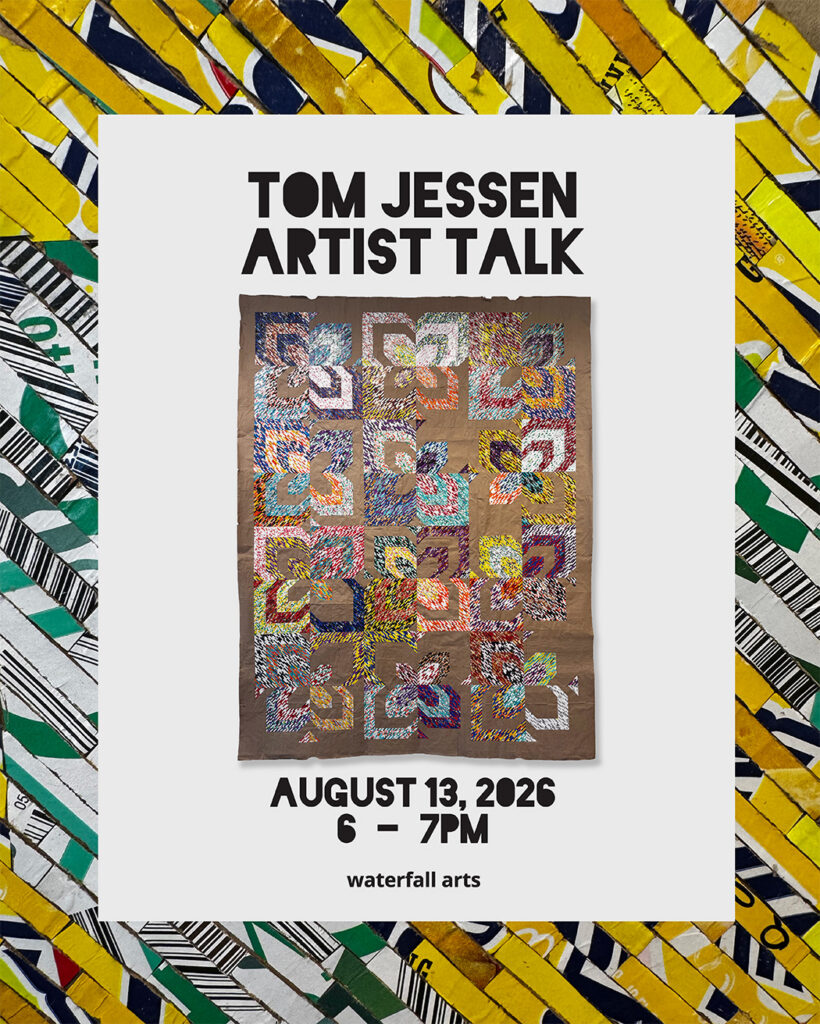
Thank you to everyone who joined us for Tom Jessen’s artist talk. Your presence, curiosity, and contributions help make our community richer; creating space for conversation, shared experience, and the exchange of ideas.
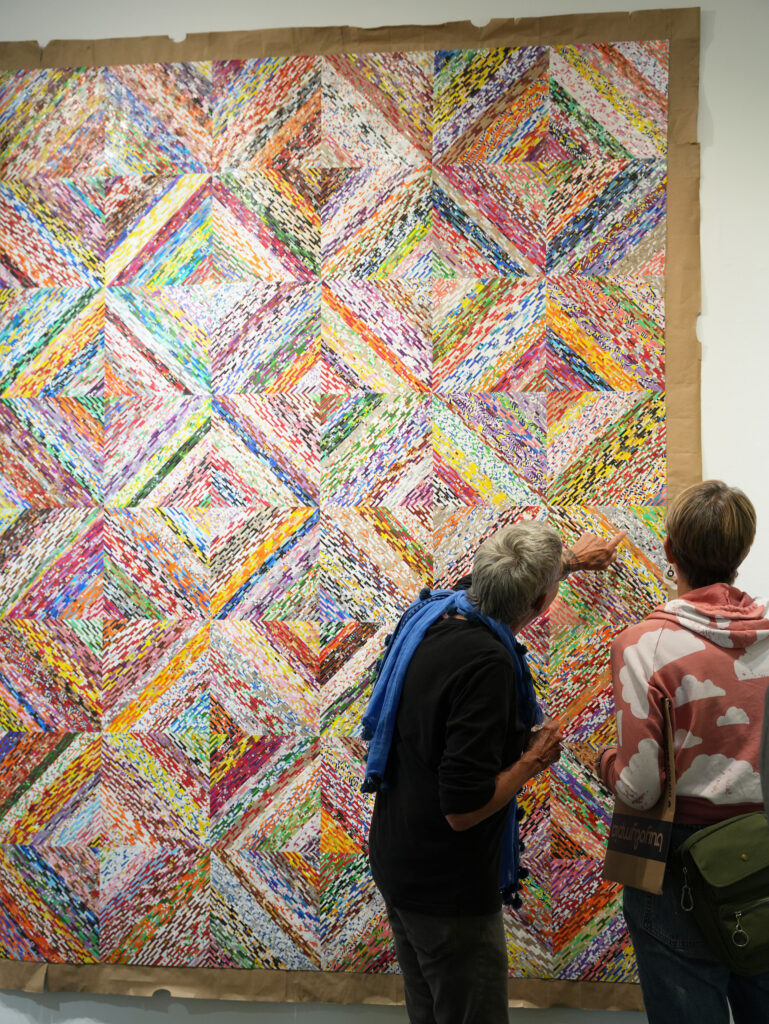 Two Press Play exhibit visitors take a closer look at one of Tom Jessen’s pieces.
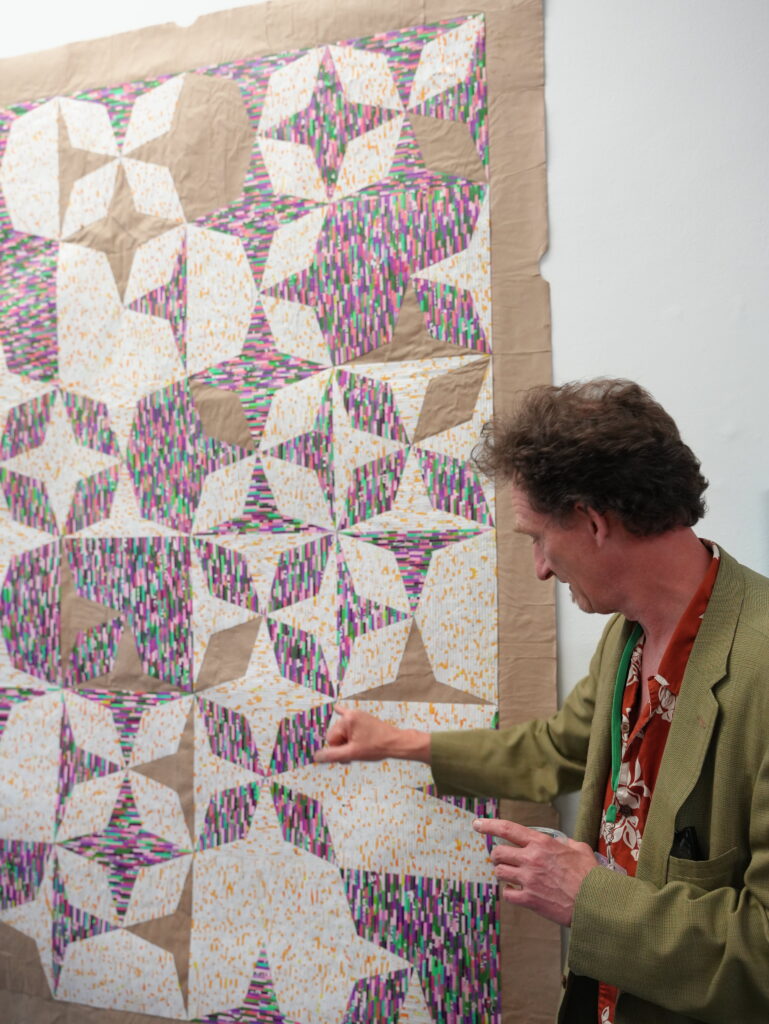 Tom Jessen talks about his work on display during the Press Play exhibit opening reception.
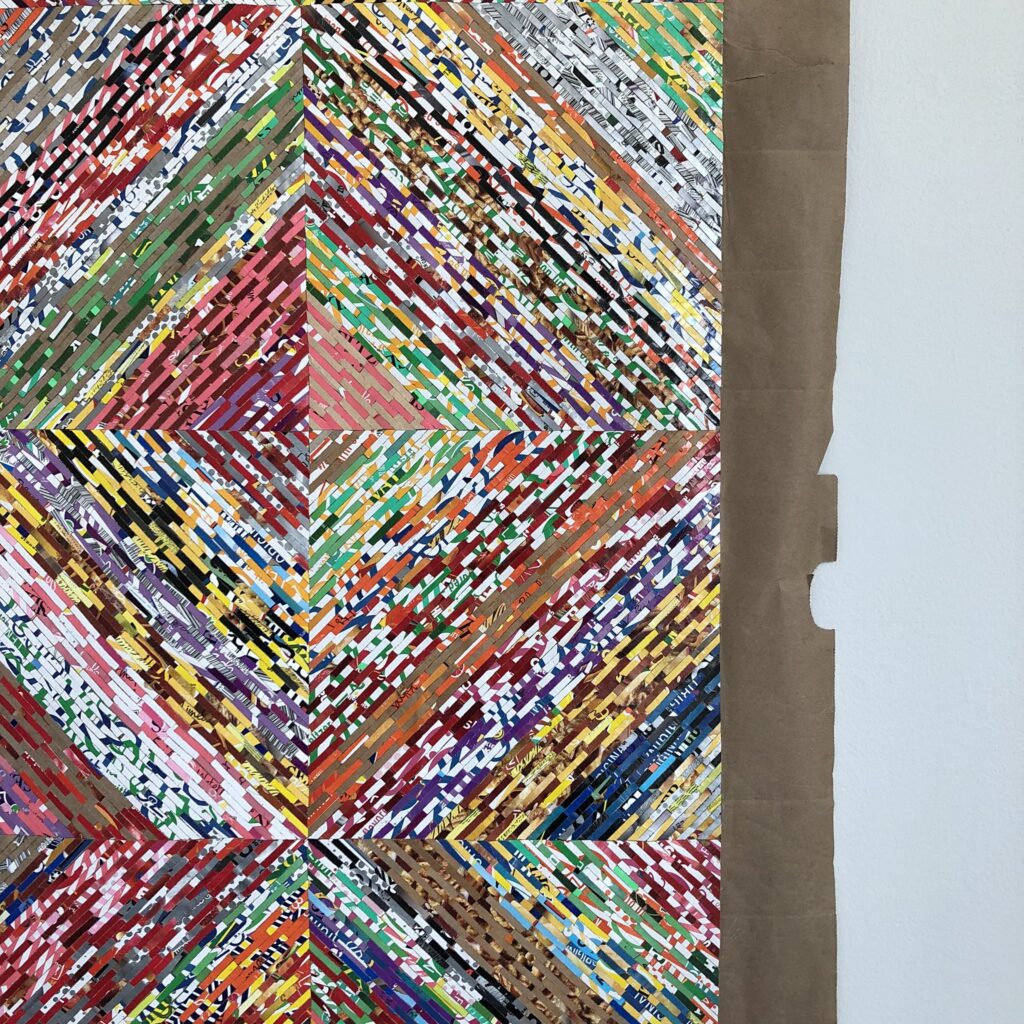 Close up of Tom Jessen’s work