Before I Die: Time, Community, and a Shared Wall
Written by Katherine Devereux, MPS, Waterfall Arts Institutional Advancement Director
This is where the communal dimension becomes most significant. If personhood is constituted through others, then the act of writing on the wall is not merely expressive but constitutive. It is a way of locating oneself within a network of shared meanings. To write forgive my brother is to acknowledge a relationship that exceeds the self. To write be remembered is to invoke a future in which others will carry one’s presence forward. Even seemingly individual aspirations, catch a really big fish, learn to paint, gain new resonance when placed in proximity to the desires of others. They become part of a broader conversation about what a life can or should be.
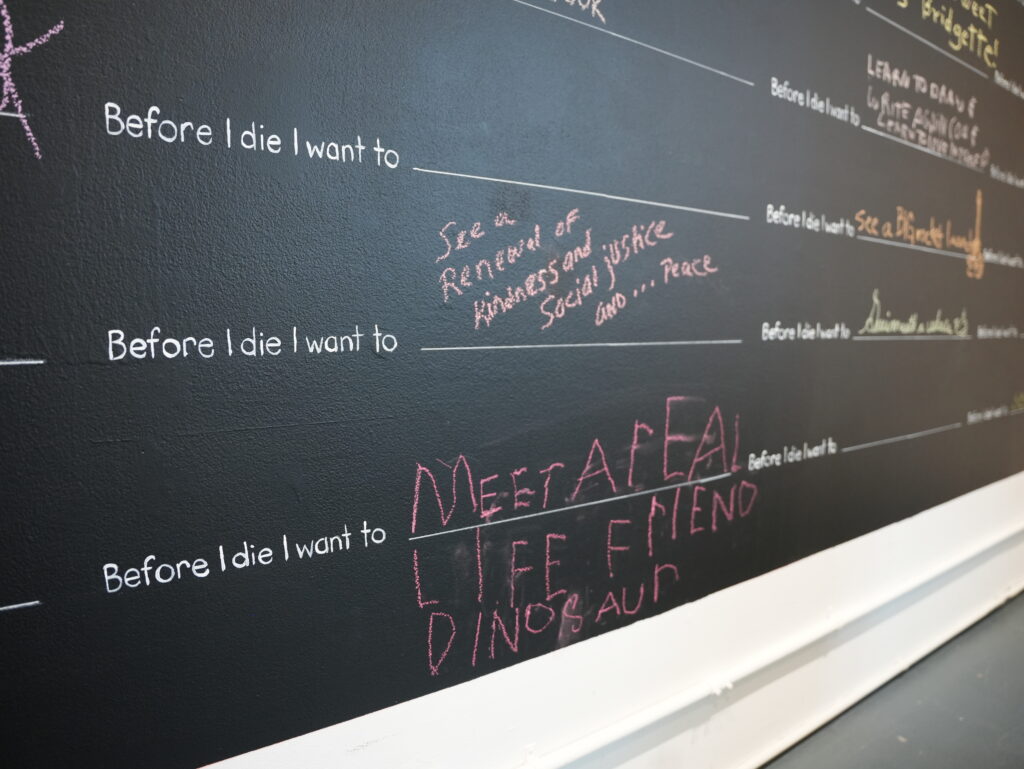
A wall filled with handwriting is not static. It accumulates. It revises itself. It holds traces of people who will never meet, yet are bound through a shared act of answering one question; Before I die, I want to…
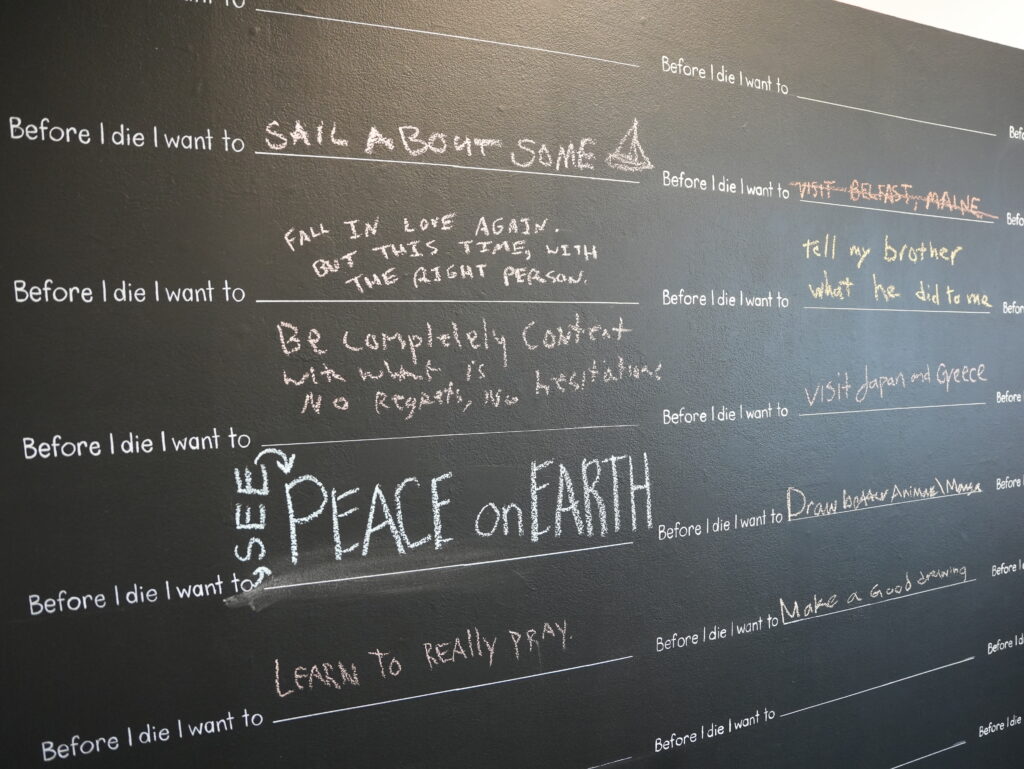
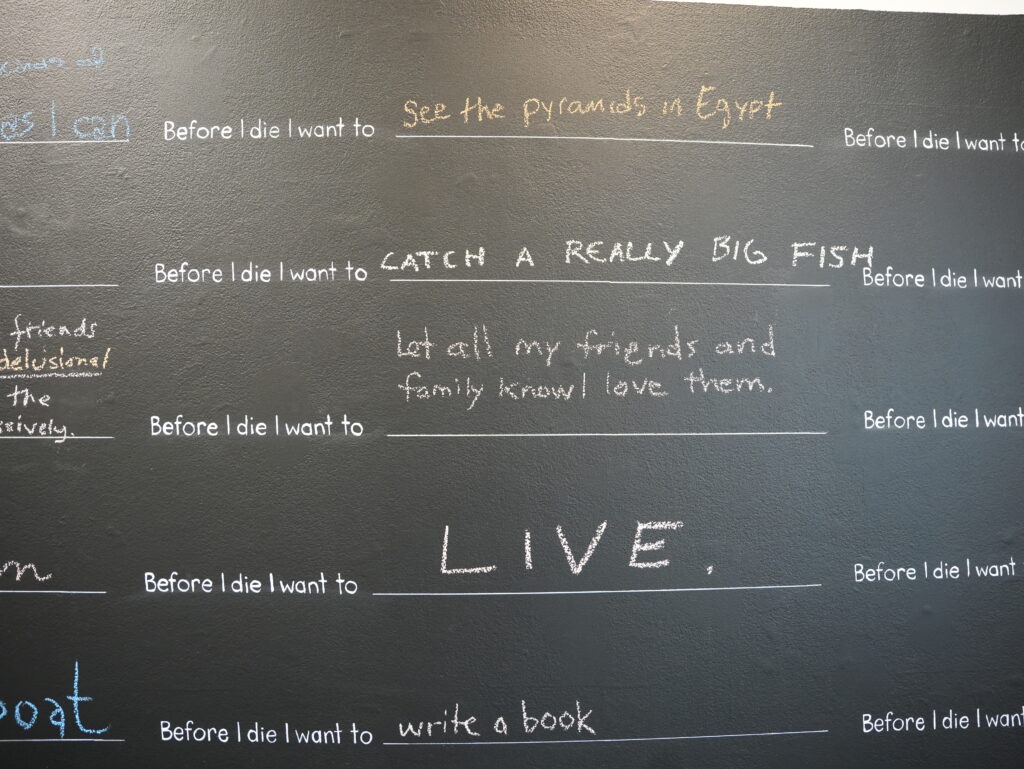
At first glance, the responses appear familiar. Some are expansive; travel the world, publish a book, learn to fly. Others are intimate; forgiveness, be a better listener, not be afraid anymore. Still others resist aspiration altogether, offering instead a quiet register of presence; feel at peace, laugh more. Taken individually, they read as fragments of private intention. Taken together, they begin to function differently, becoming less a collection of statements than a record of how a community, in a given moment, understands time, death, and what it means to live.
The installation draws from Candy Chang’s Before I Die project, first realized in New Orleans in 2011, where an abandoned house became a chalkboard for public reflection. Since then, iterations have appeared across cities worldwide, each shaped by the particular rhythms, concerns, and textures of the communities that engage it. At Waterfall Arts, the wall anchors Make Your Mark, an interactive street art exhibition that invites visitors not only to view but to participate; to write, to layer, to respond. The result is not a finished artwork but an evolving surface, a site of accumulation where meaning is produced collectively over time.
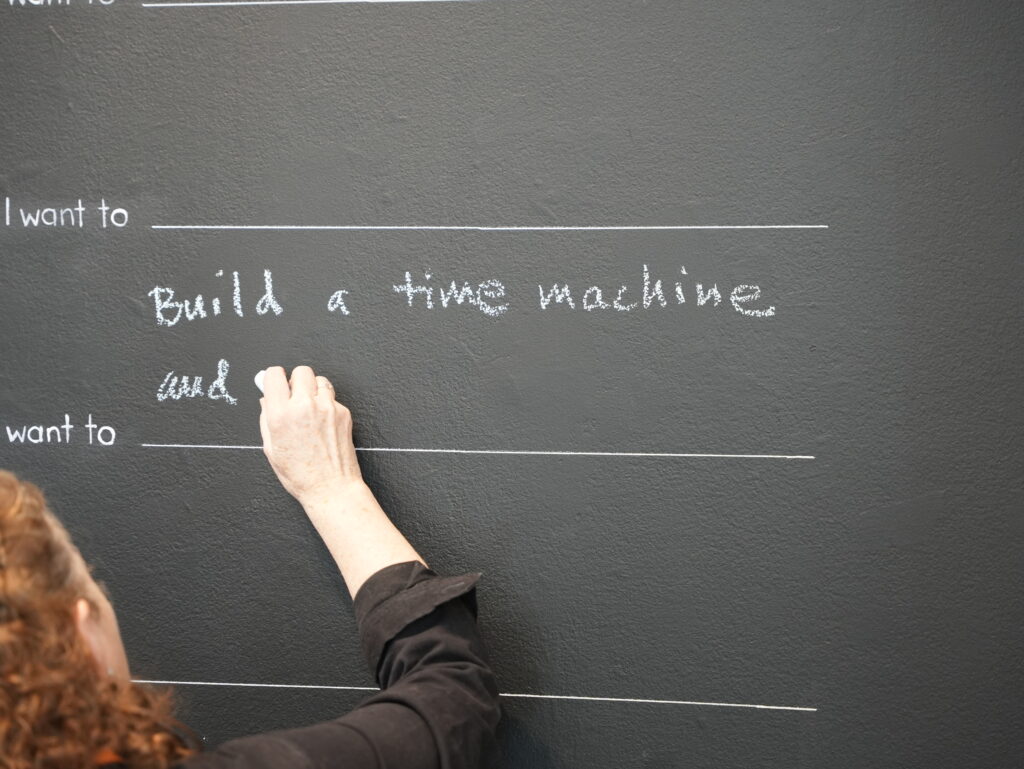
To stand before the wall is to encounter not only a series of individual desires, but a shared vocabulary of urgency, hope, and uncertainty. The prompt, “Before I die,” seems to orient each response toward the future, toward what has not yet happened. And yet the act of writing is resolutely present-tense. It happens here, in public, in relation to others who have already written and those who will write after. The wall stages a tension between temporal orientations: between life as something to be completed before time runs out, and life as something that unfolds, continuously, in relation to others, or towards a resolute end.
It is here that the work of Kenyan philosopher John Mbiti offers a useful frame, not as an external imposition, but as a way of naming what the wall already makes visible. Mbiti’s account of time departs from a strictly linear, future-oriented model. Rather than extending indefinitely forward, time is anchored in events, in what has occurred and what is occurring; the present is not a fleeting instant but a dense field of activity, thick with social and spiritual significance. Equally central is Mbiti’s understanding of personhood as fundamentally relational, often summarized in the phrase: I am because we are. Existence is not self-contained; it is constituted through others, through participation in a shared world.
Read through this lens, the wall is not simply a set of future-directed goals. It is a social act occurring in the present, a ritualized articulation of what matters, shaped by and addressed to others. Each statement is written by an individual hand, but none remain purely individual once placed on the wall; they are read, echoed, contradicted, and reframed. A declaration to learn to love myself sits beside a quieter hope to spend more time with my cat. A bold change the world is tempered by a neighboring swim with whales. The proximity of these statements matters. Meaning is not fixed at the moment of writing; it emerges in relation.
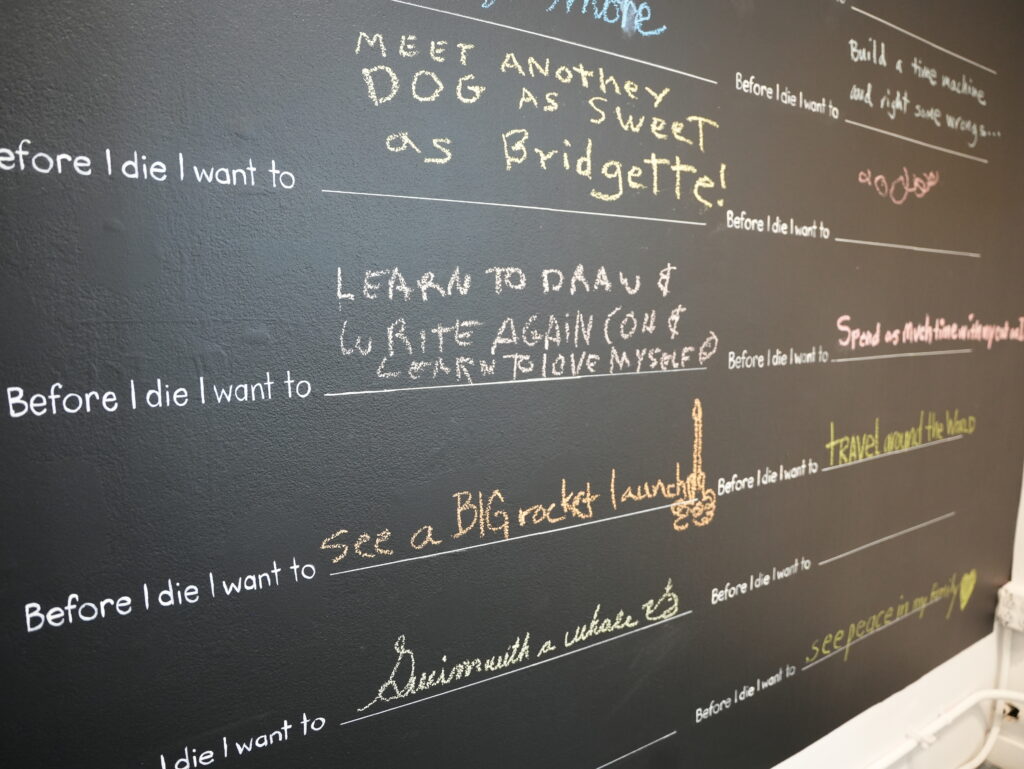
The wall, in this sense, produces a temporary community, one that exists through expression. It is public but not anonymous in the abstract; it is populated by traces of specific lives, specific concerns. And yet, as more people write, the authorship of the wall disperses. No single voice dominates. Instead, a collective language begins to form, one that reflects both shared conditions and divergent aspirations. The everyday is elevated, but not detached from its everydayness, in that, to write on the wall is not to step outside of ordinary life; it is to render that life visible, to give it form in a space where others can encounter it.
This understanding stands in productive tension with dominant Western accounts of time, particularly those shaped by modern conditions of acceleration and individualization. Contemporary social theory often frames life as something to be optimized within limited time, a horizon of future goals that must be reached before it’s too late. Within this framework, the phrase “Before I die” can become a checklist, a catalog of experiences to be accumulated. Travel more. Do more. Become more. Life as measured against what remains undone.
On the wall, this logic is present. There are entries that read as bucket-list items, as if time were a narrowing corridor and each statement a marker of progress not yet made. But these entries do not exist in isolation. They are situated among others that resist or complicate this orientation. Alongside see every continent appears sit with my grandmother again. Near eat as many cheeses as I can is feel content with what I have. The wall does not resolve these tensions; it holds them.
What emerges, then, are two distinct but overlapping temporal orientations.
In the first, individuals understand themselves as moving toward death. Time is linear, directional, and finite. The future is the primary site of meaning, and the present is valuable insofar as it contributes to what can still be accomplished. Within this orientation, the prompt “Before I die” carries an implicit urgency. There is not enough time; one must act.
In the second orientation, the individual is situated within time rather than moving through it as a trajectory toward an endpoint. Death is not simply a distant terminus but an ever-present condition, one that gives shape to life without reducing it to a race. Here, statements on the wall read less as goals to be achieved and more as reflections of what already matters. To write be present with my family is not necessarily to defer that presence into the future, but to name its importance now, in relation to others who might recognize themselves in the same desire.
The difference is subtle but profound. In one orientation, life is something to accomplish; in the other, it is something to participate in. The wall does not instruct its participants which orientation to adopt. Instead, it reveals that both are operative, often within the same individual, and certainly within the same community.
This is where the communal dimension becomes most significant. If personhood is constituted through others, then the act of writing on the wall is not merely expressive but constitutive. It is a way of locating oneself within a network of shared meanings. To write forgive my brother is to acknowledge a relationship that exceeds the self. To write be remembered is to invoke a future in which others will carry one’s presence forward. Even seemingly individual aspirations, catch a really big fish, learn to paint, gain new resonance when placed in proximity to the desires of others. They become part of a broader conversation about what a life can or should be.
The physicality of the wall reinforces this dynamic. Layers of handwriting overlap. Chalk dust smudges previous entries. Some statements are partially erased, their traces still visible beneath new ones. The surface records not only what is written, but the passage of time itself. It is an archive, but an unstable one always in the process of being revised. Photographs capture moments within this process: a dense cluster of text where space has nearly run out; a single, carefully written line set apart from the rest; a hand mid-sentence, adding to what is already there. Each image documents not a finished reply but an ongoing negotiation of meaning.
As part of Make Your Mark, the wall sits within a broader exhibition that foregrounds participation as a central component of artistic practice; this is not art to be observed at a distance, but to be entered into. The invitation is simple, write your answer, but the implications are not. To participate is to contribute to a collective artifact, to shape and be shaped by a shared space of reflection. The exhibition, in this sense, functions as a form of civic and creative infrastructure. It provides a framework within which individuals can articulate what matters to them, while simultaneously situating those articulations within a larger social field.
What the wall ultimately makes visible is not just creativity, but a mode of thinking, of engaging questions that are often held privately, and bringing them into public relation. It demonstrates that reflection on life and death need not be abstract or isolated. It can be grounded, communal, and materially present.
The wall will not last. It will be painted over, erased, replaced by another surface, another exhibit. But for a time, it holds a record: of what people in this place, at this moment, felt compelled to say when asked to consider the limits of their own lives. It holds evidence of how a community understands time, not as a uniform structure, but as something lived, negotiated, and shared.
To stand before it is to encounter not only the question “Before I die, I want to. . .” but the realization that the answer is never entirely one’s own. It is written within a field of others, shaped by their presence, and returned to them in turn. In this way, the wall does not simply ask what we will do before we die. It asks, more quietly but more insistently, “how do we live?”, together, and in time.